Increasing Float Zone Silicon Toughness for high Efficiency Silicon Solar Cells, through Locking Dislocation with Impurities
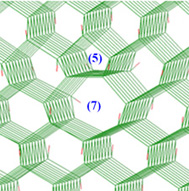
Float Zone (FZ) silicon is important for high efficiency solar cells, such as Sliver Solar Cells, and many microelectronics applications, where high minority lifetime substrates are desired. Lifetimes in the order of 10 to 12 ms have been reported, however, FZ Si wafers are brittle and inherently fragile. We proposed to dope FZ silicon with nitrogen (NFZ) to strengthen the material substrate. This project was funded by the National Renewable Energy Lab (NREL).
Nano-Junction Builder (nJB), a Computer Tool for Building and Studying Junctions of 1D and 2D Nanomaterials
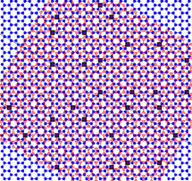
There is a strong need for computer tools that facilitate manufacturing of known nanomaterials, enable creating new ones, and construct nanojunctions, such as the hard to make 1D and 2D structures, and nanodevices involving 2D-2D materials (e.g., graphene, silicene, or combined heterostructures), 1D-1D materials (e.g., molecular chains, CNT-CNT) and 1D-2D junctions (e.g., CNT-graphene). Designing nanoscale junction or predicting its properties requires an extra design effort of atomistic systems and matching the lattice points for the joined material lumps. This project focuses on developing and integrating computer tools for prototyping nanosheet and nanotube junctions to name a few. The developed tool is called nano-Junction Builder (nJB).
.
Low Reflectance silicon wafers
Goal: Develop a process that generates Low Reflectance silicon material for Photovoltaics and Optoelectronics
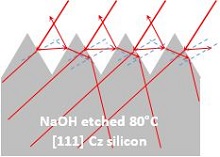
Nitrogen doped Czochralski (N-Cz) silicon wafers heat treated and etched chemically produced textured surfaces that efficiently trap light. N-Cz samples exhibited, over a wide spectral range, a very low effective reflectance, compared to other Cz samples.
Lightweight Materials for encapsulating PV Modules on UAVs.
Goal: Develop lightweight materials for the new “Glassless Encapsulation©” process for encapsulating thin silicon solar cells on UAV Wings.
When powering a UAV with a photovoltaic module, the quantity of materials added on the UAV wings and fuselage is very critical due to weight limitation. Ultra-thin high efficiency silicon solar cells, if used, must be encapsulated on the top surfaces using special materials and without the traditionally used top glass sheets. It is desired that the encapsulant has a low density, high strength, and several other properties. It must allow to be applied in very thin films that provide sufficient protection to the cell front surface and a strong adhesion of the inflexible silicon cells on the fragile UAV surface. In addition, the encapsulation must yield conformal coverage to preserve the aerodynamics of the UAV.
Photovoltaic for Unmanned Aerial Vehicles (PV for UAV)
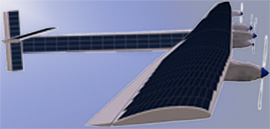
Goal: Develop an Autonomous Power Supply and energy management system to power UAVs, which can be also used for other Unmanned Vehicles and Robots.
Energy autonomy is a primary concern for many emerging machines, such as Unmanned Aerial Vehicles (UAVs). We developed a set of new technologies necessary for making a photovoltaic power supply capable of powering a UAV and enabling more functionalities. These technologies can be ported to many other machines such as mobile robots, humanoids, unattended sensors,... as well as manned vehicles and lightweight cars.